Prefer to read or forward it as a document?
Download the PDFWatch the 3-minute version
New video every week on NYPD, FDNY and 9/11 family money questions. Subscribe on YouTube
“There are three sources of competitive advantage in investing: informational, analytical, and behavioral. The most enduring of these is behavioral.”
— Bill Miller
For fifteen straight years, Bill Miller beat the S&P 500. From 1991 through 2005, his Legg Mason Value Trust fund finished ahead of the index every single calendar year, one of the most famous streaks in investing history. So when he says there are only three ways to get an edge in markets, it's worth listening. An informational edge means knowing something material that other people don't, and it's always been the easiest edge to want and the hardest to keep. An analytical edge means taking the same information everyone has and weighing it differently, seeing something the consensus is missing. A behavioral edge is simpler. People act emotionally, especially when things get volatile, and that doesn't change no matter how good the tools get. Miller's point was that the first two fade as markets get more competitive. The third one just keeps paying out.
I've been thinking about that a lot lately, because this market has felt a little off. Memory chip makers are posting more profit in a single quarter than their whole companies were worth a year ago. Most of the energy sector is trading like speculative growth stocks. Businesses that once had "unassailable moats" are getting torn up overnight because of one product announcement out of OpenAI or Anthropic. This might be the strangest market I’ve seen in a while. The index keeps hitting new highs while most of the businesses I actually study sit 50% or more below their own highs.
Nearly all the gain is coming from one narrow sliver of the market tied to the AI buildout, chips, the hyperscalers, the power and infrastructure names, while whole sectors elsewhere act like they're in their own private downturn. None of it quite adds up on its own, but markets acting strange usually means something real is happening underneath. In this case, AI capability is genuinely moving faster than most of us can track. Rather than chasing every AI headline out of FOMO, we've put our energy into using these tools in our own process and building things that help beyond our own portfolio. The free retirement calculators we built for FDNY, NYPD, and veteran families came out of that same effort, using these tools to put real financial planning in front of people who'd otherwise pay for it or go without. You won't see that payoff in a quarterly number, but the quality and speed of how we research and think through ideas has improved more in the last few months than it did in the prior several years.
That brings up a question I keep getting from clients, and Miller's three edges are the best way I know to answer it. If a machine can read every filing, summarize every call, and screen every stock before you finish your coffee, what's actually left for a human investor to do?
Start with informational edge, since it's the one AI goes after most directly. It was already the hardest of the three to hold, since markets have spent decades pricing in public information almost as fast as it shows up. AI just finishes the job. Gathering data, reading filings, building a first-pass model, a machine now does all of it faster and more completely than any analyst. Whatever thin edge was left there is gone, and it's a mistake to keep looking for it.
Analytical edge is more interesting, and I'd push back on the idea that AI kills it the same way. It does erode the average analytical edge. When most of the market uses similar tools and asks similar questions, everyone's answers converge, and that looks like sophistication but is really just crowding. Crowded trades tend to end in a violent, synchronized unwind when everyone heads for the exit at once. But that's a statement about the crowd, not a law of nature. For someone willing to think differently, these tools can sharpen an edge rather than erase it. The edge was never about who has the tool. It's about who's still willing to disagree with it.
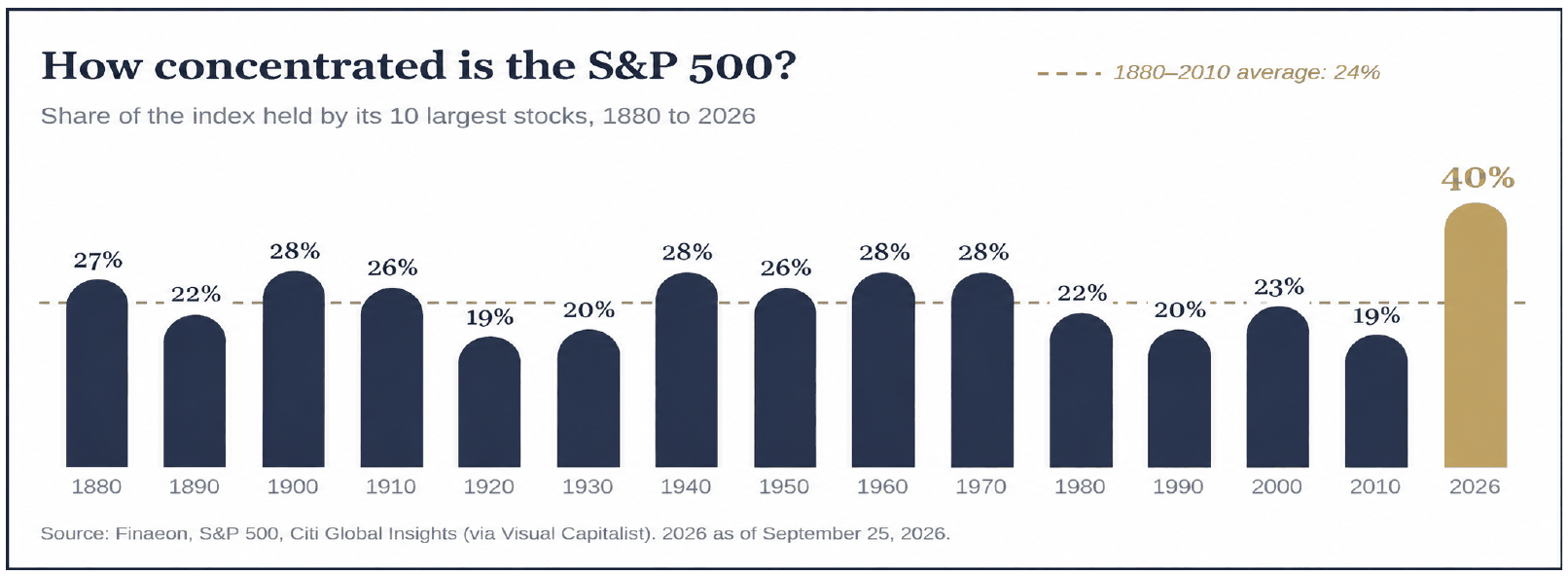
You don't have to take the crowding part on faith. According to Apollo's chief economist, strip out AI-related names and energy stocks, and the rest of the S&P 500 is in the red this year. Another count found just 23 stocks behind nearly the entire 10% gain. In a healthy bull market, 10 to 12% of S&P 500 stocks are hitting new 52-week highs in a given week. This year that number fell as low as 1%. The graph below shows how lopsided it has become: currently, the ten largest stocks make up about 40% of the S&P 500, the highest share in data going back to 1880.
That leaves a lot of boring, durable, compounding businesses sitting cheap and uncontested. Nobody's excited about them right now, and they're exactly the ones we want to own.
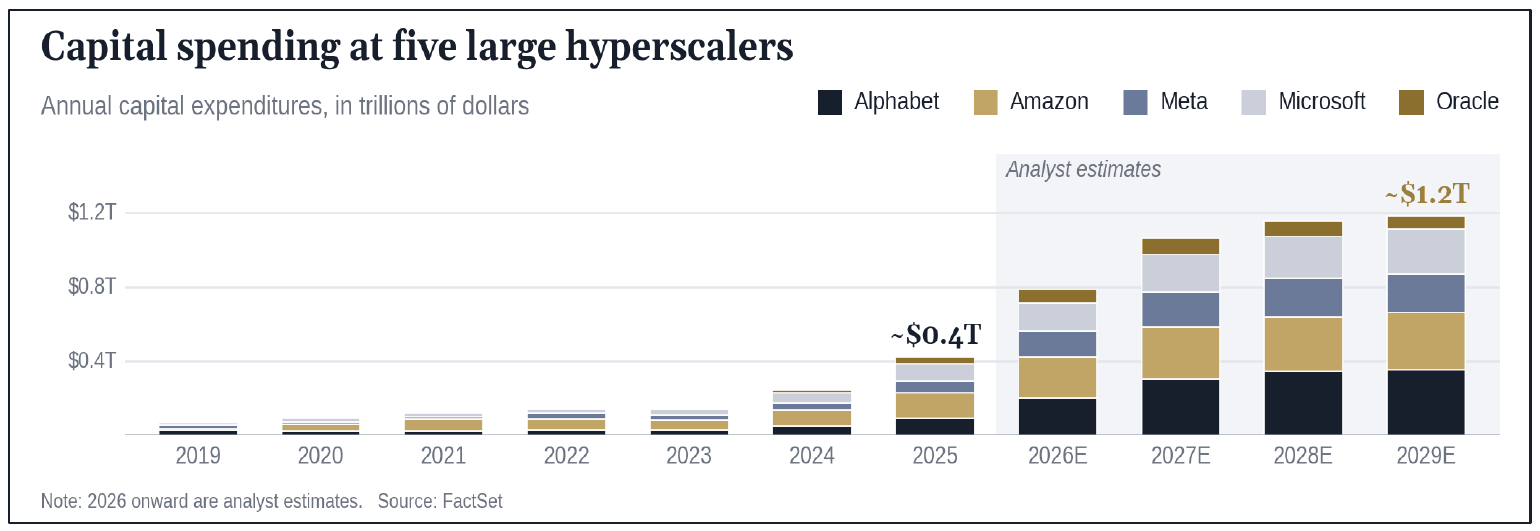
Here's the part worth sitting with. The same handful of companies driving nearly all the market's gains are also the ones quietly changing how they pay for the buildout behind those gains. In the year to June, the three largest hyperscalers nearly tripled their combined long-term debt, adding roughly $207 billion, and that's before counting the bond issuance from the broader group, which has already doubled all of last year's total. Google went further and raised $85 billion through an equity offering just to fund more infrastructure, with Oracle doing something similar on a smaller scale. Companies don't dilute their own shareholders unless they've decided falling behind is the bigger risk. Capex at the four biggest cloud builders jumped 75% over that stretch, while the cash their operations actually brought in grew only 34%, meaning a bigger share of every incoming dollar is now going straight back into data centers, chips, and power. Microsoft's the exception, still funding its buildout with cash and even paying debt down, which tells you the more aggressive path the others are on is a choice, not a necessity (see further breakdown below).
There's an old idea worth borrowing here, from the economist Hyman Minsky, who argued that long stretches of calm quietly make a financial system less careful. He split borrowers into three types. A hedge borrower's cash covers both interest and principal. A speculative borrower's cash covers the interest but keeps rolling the principal into a new loan. A Ponzi borrower's cash covers neither, and the whole thing depends on the asset they bought continuing to rise. Every hyperscaler is still a hedge borrower today, easily able to cover what they owe. What's changed is the direction of travel, and that's exactly what Minsky said to watch, along with whoever sits further down the chain.
Because the real exposure probably isn't with Microsoft, Alphabet, Meta, or Amazon. It's with the private credit funds lending against GPUs directly, usually on 3-4 year terms, loans the hyperscalers aren't even party to. Whether that's reasonable depends on how long a GPU actually stays useful, and that's genuinely contested, bears say one to two years before a chip's obsolete, bulls say ten to fifteen. If the bears are right, lenders are holding collateral that stops earning before the loan's paid off, which is exactly how a speculative borrower slides toward Ponzi financing without changing a thing they're doing. It's close to the same dynamic that sank the fiber-optic buildout in the early 2000s: telecoms borrowed heavily to lay far more cable than anyone needed, the companies carrying that debt failed, and the fiber itself turned out to be exactly what the next generation of internet companies ran on, cheaply, for years. The technology was never the problem. The financing was.
None of this means the buildout itself is unsound, and I'm not quietly talking myself into the bear case. Demand looks genuinely real and still ahead of supply, which is the best argument against the bubble framing. The emergence of AI agents could accelerate demand even further. The real risk isn't the technology but how it's financed. A correction may hurt valuations without undermining the AI revolution, but heavily leveraged infrastructure providers and lenders relying on optimistic GPU economics could face real losses. As with the internet buildout, the technology can change the world while investors financing it still lose money.
I share that value investor's view that today's concentrated, momentum-driven market may offer one of the best stock-picking environments in decades. Mispricings are increasingly common, and the real opportunity lies in identifying which companies will turn AI investment into lasting competitive advantages. Consider the internet's impact on retail. Nearly every retailer built a website, but Amazon went further, redesigning its entire business around the technology. AI presents a similar opportunity. Most companies will adopt the tools, but far fewer will have the leadership and urgency to fundamentally rethink how they operate. The difference in outcomes could be enormous. For investors, the opportunity isn't simply owning companies exposed to AI. It's identifying businesses whose earnings power, competitive position, and intrinsic value will improve far more than the market currently anticipates.
That leaves the behavioral edge, the one Miller considered most enduring. For us, that edge is the discipline to think in years, not quarters. Most fund managers face constant pressure from short-term performance, client expectations, and career risk. Our longer investment horizon gives us the freedom to look beyond market volatility and capitalize on opportunities others may be forced to overlook. As AI makes information more accessible and markets more reactive, emotional decision-making and herd behavior won't disappear. If anything, they may intensify, creating greater opportunities for patient investors. Ultimately, our advantage lies in identifying durable businesses, backing capable management, thinking independently, and having the conviction to hold when others won't. AI can make everyone a faster analyst, but it can't make everyone a better investor.
We finished the quarter with an average client return of -2.42% (compared to 2.38% for the S&P500). But short-term returns don't always reflect the quality of investment decisions. Good decisions can produce poor quarterly results, and vice versa. What matters is the process and the long-term outcomes it produces. With that in mind, I'll focus on the portfolio changes that best illustrate how we're putting this philosophy to work.
Portfolio Changes
Increased Positions
dLocal (Ticker: DLO) - The thesis hasn't changed since we laid it out last time: dLocal is the toll bridge connecting global merchants with consumers in emerging markets, where fragmented banking systems, currencies, and local payment methods make transactions more complicated. As cross-border commerce grows, we believe dLocal's infrastructure becomes increasingly valuable. The market's primary concern is margin compression as larger customers negotiate lower fees. While this is a legitimate risk, we believe the current valuation more than compensates us for it. With earnings expected to grow approximately 15% and shares trading at roughly 10 times forward earnings, we see an attractive disconnect between the company's growth prospects and its valuation. We took advantage of the recent weakness to increase our position.
Shift4 (Ticker: FOUR) - Shift4's shares declined sharply following a difficult quarter, driven in part by Middle East disruptions affecting its recently acquired Global Blue tax-free shopping business. We believe the market's reaction overlooked the strength of Shift4's core payments business and its longer-term growth opportunities. In the United States, Shift4 benefits from deeply integrated payment software across hotels, restaurants, and sports and entertainment venues. These integrations create high switching costs and durable customer relationships. Internationally, Shift4 One is already operating in 12 of its 15 targeted countries, ahead of schedule, with merchant adoption continuing to expand. We also see opportunities from Japan's transition to a refund-based tax-free shopping system, which could benefit Global Blue. The 2026 World Cup, including the final at MetLife Stadium, provides a separate, near-term opportunity for payment activity and brand exposure rather than a recurring growth driver into next year. We believe the recent selloff reflects temporary disruptions more than any fundamental deterioration in the business, and we used the weakness to add shares.
Grab Holdings (Ticker: GRAB) - Grab is the dominant super app across Southeast Asia, spanning ride-hailing, food delivery, and digital financial services in a region where a huge share of the population is still underbanked. One particularly attractive competitive advantage is GrabMaps, the company's proprietary mapping platform. Southeast Asia's cities contain extensive networks of narrow alleyways and side streets accessible to motorcycles but often missing from traditional maps. By leveraging millions of rides and deliveries, Grab has developed detailed mapping data that captures these routes, allowing drivers to navigate more efficiently, reduce delivery times, and lower operating costs. This creates a powerful reinforcing advantage: as Grab's network grows, its mapping data improves, making its services more efficient and its competitive position increasingly difficult to replicate.
Netflix (Ticker: NFLX) - Netflix remains the global leader in subscription streaming, but we believe its growth opportunity now extends well beyond adding subscribers. The company has several increasingly important drivers of earnings growth: an expanding advertising business, the ability to raise subscription prices while maintaining customer engagement, and a growing presence in live sports and events. Together, these initiatives create additional ways to monetize Netflix's enormous global audience without relying exclusively on subscriber growth. Competition for consumer attention remains intense, particularly from short-form video platforms. However, Netflix's global distribution, extensive content library, recommendation technology, and scale in content investment create competitive advantages that are difficult to replicate. We believe the market continues to underestimate Netflix's long-term monetization potential and added to our position during the quarter.
New Positions (Small <1%)
Linde plc (Ticker: LIN) - Linde operates in one of the best industry structures available to a long-term investor: industrial gases is effectively a global oligopoly, and most contracts are long-term, on-site arrangements with built-in price escalators tied to inflation. That's about as close to a toll road as you get outside of payments. Linde also sits at the center of several genuine secular tailwinds, semiconductor fabrication, hydrogen, and industrial decarbonization, all of which require the specialty gases Linde supplies. We started with a small position while we continue building out the full thesis.
Kaspi.kz (Ticker: KSPI) - Kaspi is Kazakhstan's dominant super app, combining payments, an e-commerce marketplace, and core banking into a single platform that touches the vast majority of the country's digitally active population. The business generates extraordinary returns on equity, and it's benefiting from the same digitization and financial inclusion tailwind that made names like Nubank and Grab compelling early on, just a few years earlier in the cycle and in a market most US investors haven't looked at closely. This one came to us through conversations in our own investing circle, and we're starting small while we do more work on it.

About
A West Point graduate with an MBA from Notre Dame, William held senior positions at EY and Deutsche Bank before founding Sirmium Capital over a decade ago. He is a Series 65-licensed investment adviser representative specializing in value investing for families impacted by September 11th.
The full issue as published, with both charts.
Download the PDFGet the next issue in your inbox
Market outlook, portfolio update, and one researched stock idea, four times a year. Free, no spam, unsubscribe anytime.
You're in. The next issue will land in your inbox.
Something went wrong. Please try again.
Disclaimer
This document and the information contained herein are provided by Sirmium Capital, LLC (“Sirmium Capital”) solely for educational and informational purposes. Nothing herein constitutes, or should be construed as, an offer to sell or a solicitation of an offer to buy any securities or other financial instruments. Any responses to inquiries that may involve the rendering of personalized investment advice, or the effecting of securities transactions will not be made absent compliance with applicable laws and regulations, including investment adviser or broker-dealer registration requirements, or applicable exemptions or exclusions therefrom.
This document, and the information contained herein, may not be copied, reproduced, distributed, transmitted, published, or disclosed, in whole or in part, to any other person without the prior written consent of Sirmium Capital. By accepting and reviewing this material, you agree to comply with these restrictions and acknowledge that your compliance is a material condition to Sirmium Capital providing this information to you.
The information and views expressed herein reflect those of Sirmium Capital as of the date indicated and are subject to change without notice. Sirmium Capital has no obligation to update or revise any information contained herein. No representation is made, and it should not be assumed, that past investment performance is indicative of future results. All investments involve risk, including the potential loss of principal.
Certain information contained herein regarding economic trends, market data, or other third-party sources has been obtained from publicly available information or other sources believed to be reliable. While Sirmium Capital believes such information to be accurate, it makes no representation or warranty as to its accuracy or completeness and has not independently verified such information. Third-party sources referenced herein make no representations or warranties regarding any information attributed to them and shall have no liability in connection with the use of such information.
Sirmium Capital LLC is a New York state-registered investment adviser and is not registered with the SEC. Registration does not imply a certain level of skill or training. This letter is educational and is not personalized investment advice, and the positions discussed are not recommendations to buy or sell any security. Past performance does not guarantee future results.